Resources

Code & reading

Checklists from the field, independent research into LLM internals, open‑source code, and three ways into the articles.

01

Field checklists.

Short, usable versions of the methods in the write‑ups. Each links to the full argument and downloads as a one‑page PDF for your team.

Test feature stability before deployment

  1. Marginal stability: does the feature's distribution hold up under resampling?
  2. SHAP stability: does the model's reliance on it hold up under resampling?
  3. Where the two diverge is where deployment surprises live
  4. Fit a decay curve across pool sizes: a high floor means instability that more data won't fix
  5. Check directional stability across subpopulations

Your Best Feature Might Be Your Biggest Liability Field guide PDF, one page

02

Try the method.

The bootstrap learning-curve method behind the credit model, as an instrument you can drive.

Example feature
rows, log scale. Drag, or use the arrow keys.
Pool size n
12,000
Spread at n
0.029
10th to 90th percentile across 40 resamples
Fitted floor
0.006
instability left at any n
Instability at n, fitted
0.048
Volume 0.042Floor 0.006

More data will stabilise this feature. The floor sits near zero, so the curve keeps falling as the pool grows.

Fitted curve 5.54 / n0.52 + 0.006

Simulated data. An illustration of the method, not a client dataset.

03

Inside the models.

Independent research into LLM internals: activation‑level control, not API‑level prompting.

The refusal direction, block by block. Schematic. Measured mean angle between consecutive transformer blocks: 93.4° in Qwen3.5‑9B, 88.8° in Mistral‑7B.

Interpretability

The refusal axis is layer‑local.

“Stack a deck of cards. Rotate each one slightly from the one below. Now try to push all 52 cards straight. You cannot: the same push that catches card 7 perfectly misses card 13 because it is facing a different way. That is what is happening inside these models.”

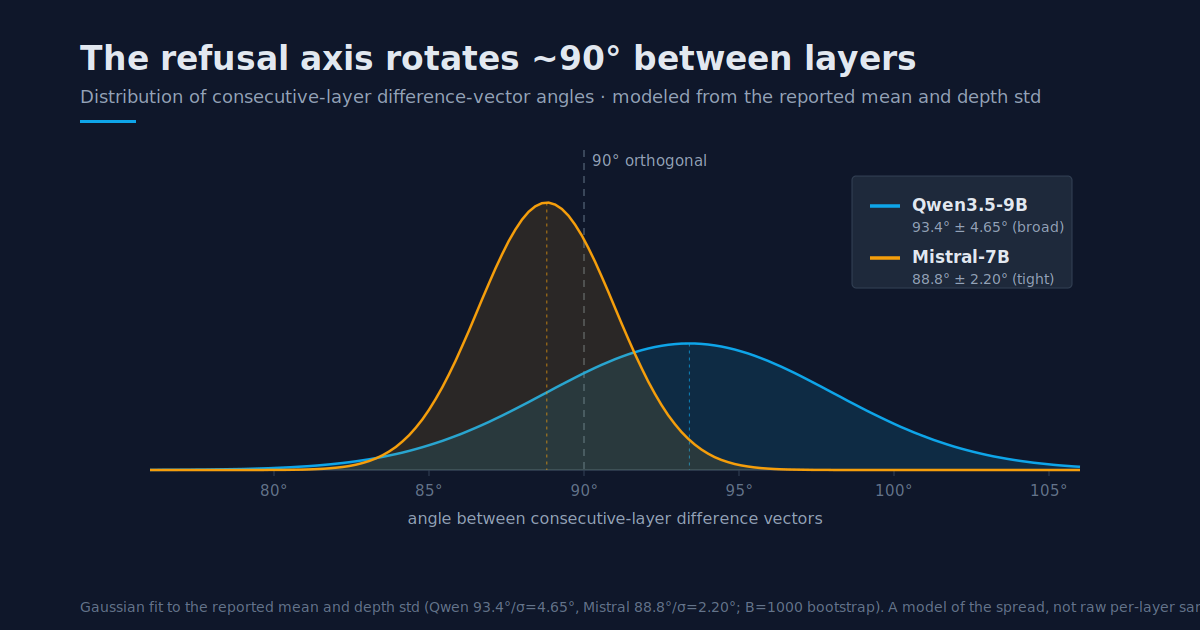
The refusal axis rotates ~90° between consecutive transformer blocks, so single-vector steering hits a geometric ceiling.

Measured across Qwen3.5-9B and Mistral-7B on BeaverTails, 12 harm categories. Pushing toward refusal is cheap; pushing toward compliance degrades output before producing it. Extends the refusal-steering method of García-Ferrero, Montero & Orus (arXiv:2512.16602). My own results, cross-checked against the committed data: 12 of 12 claims reproduce.

Modeled distribution of consecutive layer difference vector angles. Mistral-7B is a tall narrow peak just below 90 degrees (88.8 degrees, std 2.20); Qwen3.5-9B is a broader peak just above (93.4 degrees, std 4.65); both straddle a dashed 90-degree orthogonal reference line
Distribution of the consecutive layer difference vector angle, both families: a Gaussian fit to the reported mean and depth std (Qwen3.5-9B 93.4°/σ=4.65°, Mistral-7B 88.8°/σ=2.20°; B = 1000 prompt bootstrap).

Agent safety

Self‑bootstrap exfiltration in open‑weights agents.

0

autonomous self‑bootstrap in 1,332 mundane control trials

~36%

pooled compliance under tool‑response poisoning

20+ configurations across 9 families (12 to 120B), ~14,000 real trials, escapement harness, open source.

04

Selected code.

Four repositories, each linked to its write‑up where there is one.

05

Also worth a look.

Smaller builds and tools.

folktale

An offline AI story-writer running three small language models on a jailbroken 2015 Kindle Paperwhite. No cloud, no PC, no internet.

Lua

llm-steering

Statistical toolkit for refusal steering. Uses judge scores to weight training data, correlation analysis to identify effective layers, and automated alpha optimization.

Python

vllm-stack

Dockerised multi-instance local inference: vLLM server management for an NVIDIA RTX 5090, with HuggingFace model management.

Shell

Everything on GitHub

Work with me

Available for LLM, credit risk, fraud, and KYC engagements. Book a call to discuss your project or send an email if you prefer async.

Book a call Email instead

  • Fully remote
  • Short, medium and long-term contracts
  • UK, US and international clients
  • Async first, working with teams from US West Coast to Singapore time

jordan@jordanbrowne-moore.com